Ace Business Desk – Investors celebrated the news that Nvidia has welcomed Jensen Huang back, sending the company’s shares soaring more than 31 percent Monday. The entire market got a lift on the news, with the Nasdaq Composite climbing 6.1 percent Brietbart Business Digest Report
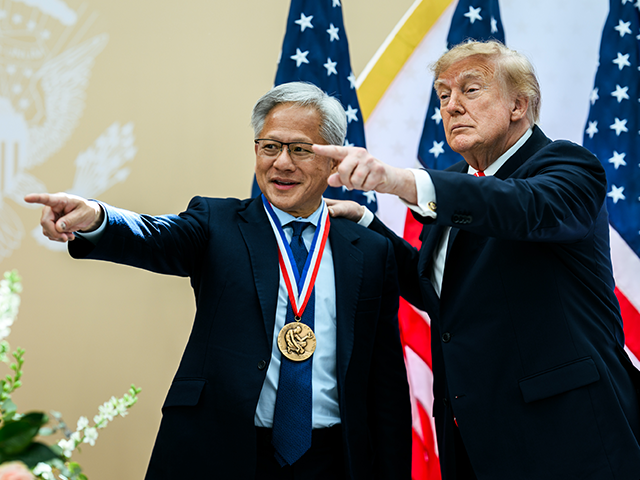
While the enthusiasm over Huang’s return is understandable, the market may be underpricing the risk to the company and the greater superintelligence economy from the inevitable political backlash. This is because Huang did not just return from corporate exile. He was rescued by President Donald Trump.
“I convinced them,” President Trump told CNBC on Monday, explaining how Nvidia’s board agreed to reinstate its founder as chief executive. The board wanted to know whether Huang posed a national-security risk. Trump said his administration told them he didn’t. Trump also said the Justice Department’s investigation had cleared Huang personally on the export-control issue.
These conversations with the board followed statements on Friday and Sunday night from President Trump that he believed the company should reinstate Huang. No less than Vice President JD Vance was dispatched to push for Huang’s return.
This was a dramatic 180 on the part of the board, which had said just last week that it didn’t intend to bring Huang back. Now he’s back, and the president of the United States is taking credit for the reversal on television. Nvidia is a Trump company now, and Huang is more or less a member of Trump’s cabinet, the Secretary of Superintelligence.
Democrat Backlash Is Ironclad
Wall Street may be underestimating what that means. In contemporary politics, Trump’s endorsement of a policy automatically draws opposition to that policy. Once upon a time, many Democrats endorsed protectionist measures such as tariffs. Now the party is deeply and almost universally opposed to them. That’s how Trump Derangement Syndrome works.
Huang’s restoration at the hands of Trump will almost certainly mean that the Democrats will see Huang and Nvidia as targets. The influence Huang once had within the Democratic Party—and it was considerable during the Biden administration—has almost instantly evaporated. Indeed, the Democratic leadership on Monday immediately reacted to the news of Huang’s return with anger, accusations, and promises of investigations and regulation.
“The Trump Administration’s rush to reinstate Jensen Huang underscores the need for Congress to act. Trump is putting his own financial interests and the needs of his billionaire buddies before our national security, emphasizing that he’s learned nothing from his resounding election defeat,” Chuck Schumer said on X. “Democrats will wield their full power to investigate any wrongdoing by the Trump Administration, Jensen Huang, other NVIDIA executives, and anyone selling out our national security for financial gain. We’ll also work on a bipartisan basis to continue advancing policies that stop the flow of our most powerful technology to the Chinese military and other adversaries.”
House Democratic leader Hakeem Jeffries—who will likely be Speaker of the House next year—wants “ironclad export control legislation” in the annual defense bill.
“This reckless decision to bring back Jensen Huang does not change the fact that Huang and NVIDIA still owe Congress answers. The Trump Administration needs to explain what ‘input’ was given and by which senior officials to support Huang’s reinstatement. Huang’s return only increases the urgency to pass bipartisan export control bills and make sure NVIDIA does not lobby to kill that legislation and put our national security at risk,” Sen. Elizabeth Warren said on X.
These hearings and investigations will not be good for business, especially since investors are so convinced that Huang is indispensable to its success. And “ironclad” export restrictions are exactly what Huang has argued against for years. His position has been that overly restrictive rules on U.S. technology would encourage foreign companies to purchase hardware from China and encourage China to develop its own technology to meet this demand. He even argued that China’s development could be stymied if the U.S. allows Chinese AI developers access to Nvidia technology.
We’ve argued here that this was always myopic. China had no intention of remaining reliant on American technology. Xi Jinping’s entire economic program is based on the idea of technological independence. China was only going to use American hardware until it became satisfied that its own technology was good enough to banish the influence of Nvidia and other U.S. chipmakers.
Huang’s return at the behest of President Trump almost guarantees that most Democrats will now reject the argument against stringent export controls. Democrats will enjoy getting to the right of the Republican Party on China trade restrictions.
Bipartisan Support for Export Controls
And they are likely to find support among Republicans. “The risk of extortion by a Chinese asset who’s been banned by Singapore is risk enough to not rehire Huang. The worst part of this is what we may never know. Congress should immediately pass the strictest export controls possible,” Sen. Kevin Cramer, the North Dakota Republican, said on Monday. Two other Republican senators, John Curtis and Pete Ricketts, also challenged the decision to bring Huang back.
The most important Republican here may be Arkansas Sen. Tom Cotton. Before the reinstatement, the chairman of the Senate Intelligence Committee told The Wall Street Journal that Commerce Secretary Howard Lutnick had ignored his warnings about companies suspected of diverting Nvidia chips to China. Cotton said several bills already had broad support in both chambers and suggested they could command veto-proof majorities. “They will become law one way or the other,” he said.
The Democrats will have 54 Senate seats in the next Congress, plus two left-wing independents who caucus with them. Cramer, Curtis, Ricketts, and Cotton might plausibly bring the Nvidia skeptics up to 60, the number necessary to overcome a filibuster. It’s not impossible that “ironclad” export controls could attract a veto-proof majority of 67.
The Democrats May Turn AI Labs into Utilities
And it might not just be Nvidia that comes under fire. Trump was already making support for superintelligence part of his political identity, pushing Democrats deeper into opposition to data centers and AI development. The transformation of Nvidia into a Trump subsidiary will accelerate the Democrats’ march toward becoming the anti-AI party.
The most likely outcome is not a ban on AI altogether but the decision to treat AI companies as regulated utilities. That would likely involve a special federal commission to supervise AI, requiring AI licenses to operate, strict limits on the activities of the companies, “rate caps” on what they can charge, and limits on the profit margins. Look at the prices investors are paying for Anthropic and SpaceX. Where, exactly, is the discount for the possibility that Washington gets a say in how much money their AI businesses are allowed to make?
That question goes upstream, too. A regulated utility whose rates are capped has a lot less reason to pay whatever it takes for computing power. It will bargain harder with its cloud provider, and the cloud provider will have a harder time justifying its next enormous order of super-powered microchips. So Amazon, Meta, Google, and Nvidia all get drawn into the web of regulation and diminished earnings.
Trump got Jensen Huang his job back. The AI industry may spend the next few years finding out what his endorsement is worth.
At Sterling Publishing & Media Service Agency, we prioritise transparency and accountability in all our operations. We wish to clarify that we are not responsible for any external content, hyperlinks, or costs associated with our services. Nevertheless, we remain committed to delivering outstanding services and greatly value your continued support. Thank you for your trust in us.

