Ace Breaking News – In Short – The Telegraph infiltrated the booming online market for counterfeit cash, where sellers take minimum orders of £250 for £1,000 in fakes Telegraph News Reports by Samantha Preston & Additional production by Louis Brady, Ben Blease and Niamh Robinson: Published: 15 September 2026

Fake cash is changing hands in Britain’s high streets, and people have no idea if it’s ending up in their wallets.
One seller, who sends notes through the post under the nose of Royal Mail, claims to earn £100,000 a year.
Exposed: the fake cash flowing through Britain
They uncover the trail of fakes from China to social media platforms.
Telegraph confronts the dealers making thousands a week selling counterfeit notes
The South London park is deserted by the time “Pete” arrives. It’s closing in on 10pm. As he takes his place opposite me on a park bench, he is careful to keep his balaclava pulled up over his nose.
His dark sunglasses reflect the notifications popping up on his screen. They are customers, looking to buy fake cash – and there are lots of them.
Pete, as we will call him, spoke to us in a rare interview as part of an investigation into the rising tide of counterfeit bank notes coming into Britain from China and being sold on social media platforms.
He plays just a small part in the online networks successfully infiltrated by The Telegraph. But he has made a significant amount of money.
“I’ve easily made £100,000 a year, if not more,” he tells me, adding that “agents” advertise his counterfeit notes on platforms such as TikTok and Instagram.
The Telegraph found sellers using the same platforms to offer bulk discounts on fakes and claiming their notes could be spent in venues from Wetherspoons to Selfridges.
Posts direct users to encrypted messaging apps, where they place orders and are told they must pay using cryptocurrency.
Pete claimed he had more than 16,000 members in his group on Telegram.
He tells me he mainly operates out of the South East, sourcing his product from within the traveller community, which he claims has access to a small counterfeit cash factory.
“I’ve actually seen a few million in fake money,” he says. “I’m only one person who works for them… And they’ve got people up and down the whole country.”
He claims to make £4,000-£5,000 per week, sending notes through the post under the nose of Royal Mail.
Customers come from as far as Newcastle or Liverpool, while the smallest order he accepts is £250 for £1,000 in fakes. The biggest he has ever received totalled some £100,000.
“The normal Joe Bloggs has no clue,” he says. “They’ve probably got fake money in their wallet right now and don’t even realise it.”
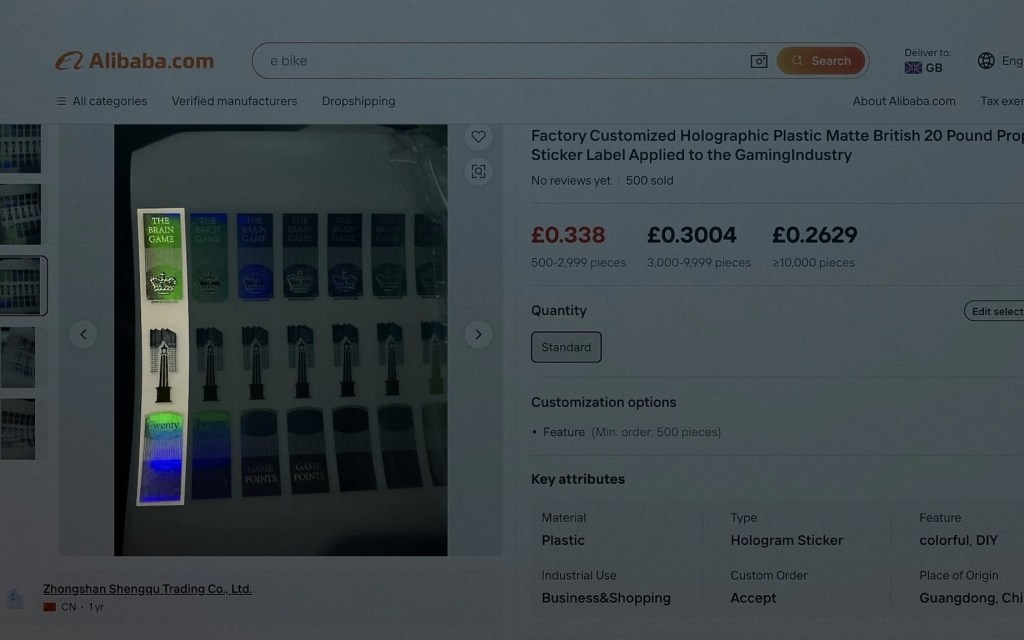
The Telegraph also found sellers advertising so-called “prop cash”, where holographic, foil stickers are stuck over warnings identifying notes as replicas intended for use in film or TV productions.
As with “traditional” counterfeits, it is a criminal offence to use prop notes as payment.
Bank of England guidelines state that props must be one-sided and substantially different in size from genuine tender.
It is also illegal to possess, supply or apply the foil stickers used to disguise prop-style counterfeits.
Despite this, The Telegraph found 500 holographic strips being offered by a China-based seller on Alibaba for £148.
The changing market has alarmed authorities, who have warned of exports from China infiltrating the UK.
Neil Harris, the head of the National Counterfeit Currency Unit at the National Crime Agency, said his team has observed an increase in the use of counterfeit notes, with the £20 note the most commonly seen.
He said that fakes often have certain giveaways, like the “Bank of England” wording across the top being smooth instead of raised. But he added that its international department was regularly engaging “with partners in China to tackle this overseas threat to the UK from the production and export of counterfeit bank notes and hologram simulations from China”.
The comments follow a major European operation in which more than 90pc of counterfeit currency seized was linked to shipments from China.
Operation Decoy III, involving authorities from 18 countries including the UK, stopped an estimated €1.2bn (about £1bn) in counterfeit notes and coins between June and November last year.
Europol said that China’s vast manufacturing capacity, low-cost production and advances in printing had made imports of counterfeits “even more prevalent”.
Since then, there have been 20 further UK seizures of counterfeit sterling and euros, unfinished notes and foil stickers used to enhance them.
The consignments were seized at airports which handle freight and originated mostly from China, with some routed through Hong Kong.
Prof Nicholas Ryder, a financial crime expert, added that the promotion of counterfeit currency on social media and improved printing methods has transformed the trade, describing it as an example of the “globalisation of financial crime”.
If produced on a large enough scale, counterfeit cash can distort the supply of money in the economy and risk pushing up inflation.
For businesses left holding a fake note, the loss is immediate.
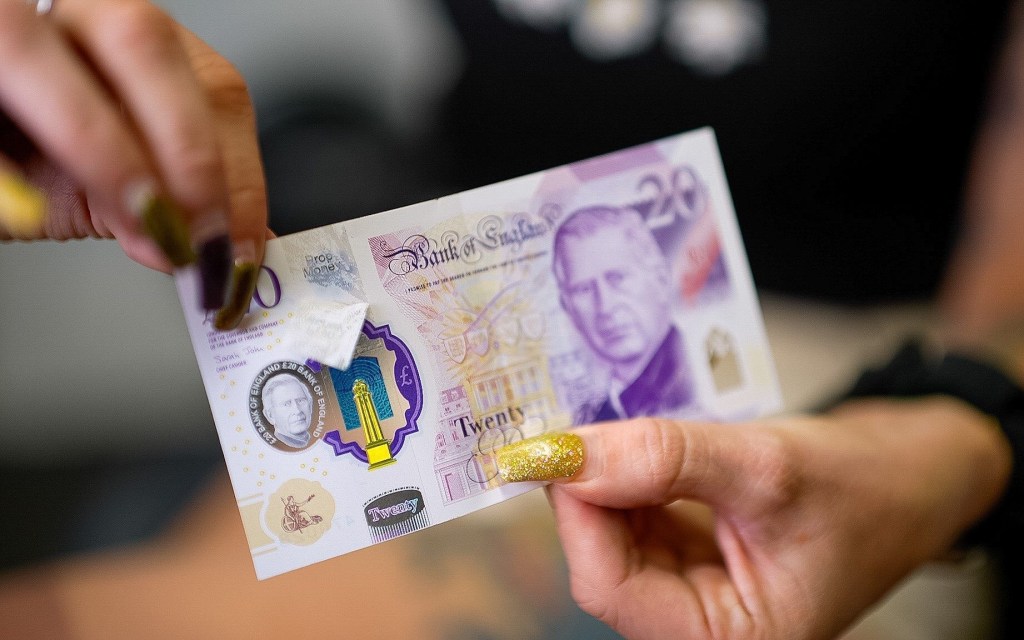
Gemma Bell, the owner of The Candy Garage, was left with two fake £20 notes after they were unknowingly accepted by a member of staff at a busy event.
Peeling back a foil sticker revealed the words “prop money” underneath.
“I was so angry and frustrated, as I work so hard with my business,” she says. “It’s my income, and so it has an effect on my family.”
But The Telegraph also found would-be buyers were themselves being targeted by scammers.
Some sellers demanded payment upfront before disappearing. Others appeared to run elaborate “wash-wash” scams.
In such schemes, fraudsters use sleight of hand and chemical tricks to create the illusion that they can “duplicate” money. The aim is to convince victims fake notes can be created and to get them to hand over large amounts of genuine cash.
During one undercover meeting, a man claiming he could “develop” counterfeit notes attempted to persuade a Telegraph reporter to withdraw £40,000.
Tony Sales, the co-founder of We Fight Fincrime, described such cases as the “perfect crime”, where a victim may feel reluctant to report what has happened.
“Due to the climate with finances, prices increasing, the normal working person is looking for a way that they can subsidise their salaries. For these types of [criminals], that’s what they prey on,” he added.
The Bank of England insists that counterfeits remain a tiny fraction of notes in circulation. Yet the number of counterfeits detected in 2025 rose to 200,000, from a record low of 99,000 in 2024.
Victoria Cleland, the Bank’s chief cashier, said that the introduction of polymer notes has stamped out organised counterfeit production in Britain, but that more now come from overseas.
After The Telegraph’s investigation, Telegram said the sale of counterfeit money was explicitly forbidden on its platforms and that moderators using AI routinely remove such content.
All the TikTok accounts flagged to the social media platform by The Telegraph were subsequently banned for breaching its community guidelines.
According to TikTok, it does not allow attempts to scam, trick or defraud people and it has strict rules against violent and criminal behaviour.
Meta, which owns Instagram and WhatsApp, said fraudulent activity was prohibited and the offending content flagged by The Telegraph had been removed.
A spokesman for Alibaba said listings relating to the replication of banknote security features breached its policies and that it adheres to all applicable laws in markets it operates in.
Royal Mail said it was legally obliged not to open post, but it routinely reported suspicious items to the authorities for inspection, and assisted in investigations into items arriving from abroad.
At Sterling Publishing & Media Service Agency, we prioritise transparency and accountability in all our operations. We wish to clarify that we are not responsible for any external content, hyperlinks, or costs associated with our services. Nevertheless, we remain committed to delivering outstanding services and greatly value your continued support. Thank you for your trust in us.

