GlobalWarming & ClimateChange News Desk – The year 2026 is expected to be Earth’s 2nd-warmest year on record, with 2027 likely to be the warmest: by Jeff Masters and Bob Henson, Yale Climate Connections: Published: November 12, 2026
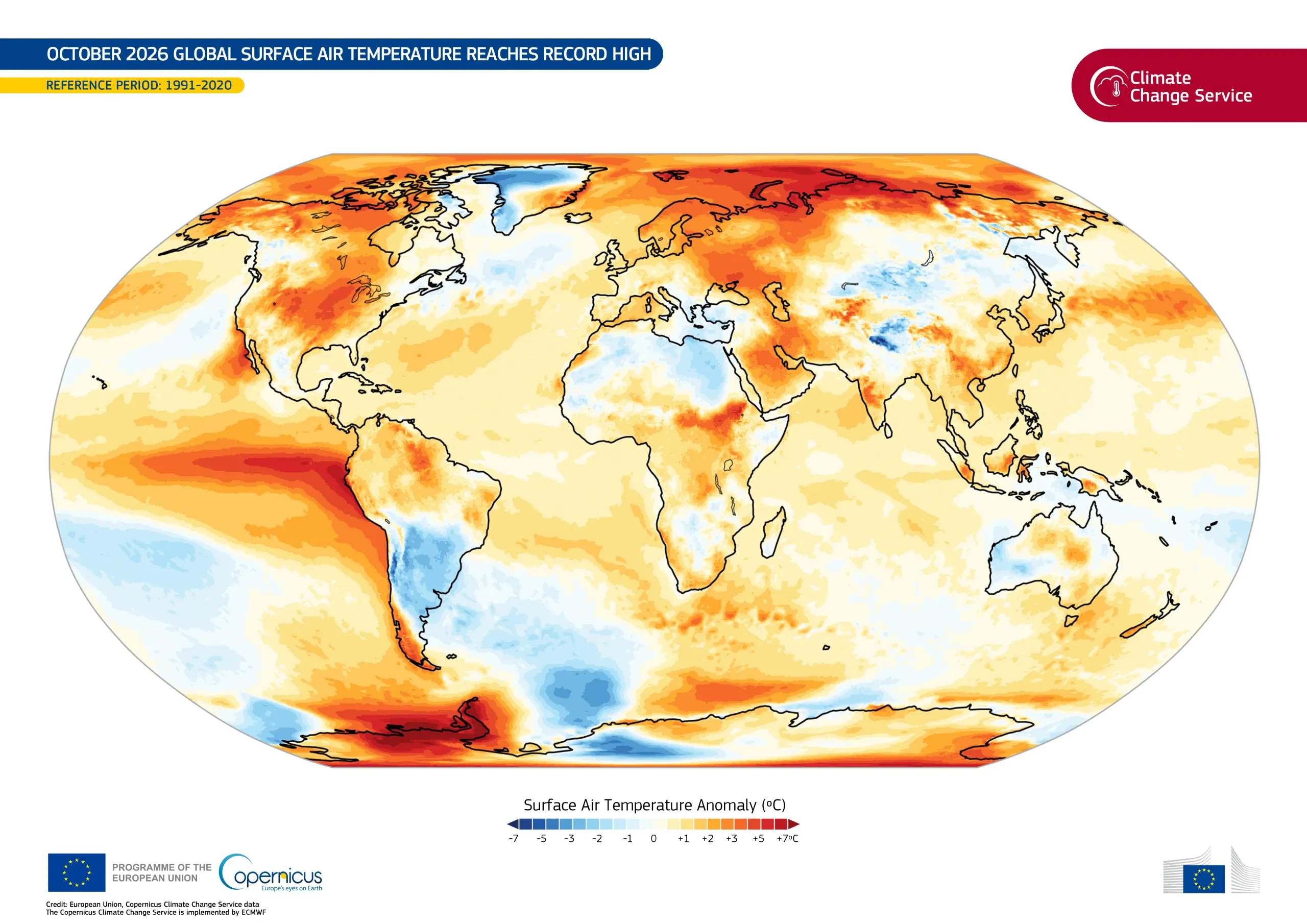
Data published by the Copernicus Climate Change Service (C3S) ahead of the conference show that October 2026 was the warmest October on record globally. The average global surface air temperature reached 15.35°C, 0.90°C above the 1991-2020 average and 1.75°C above the estimated pre-industrial level (1850-1900). October was also the third consecutive month with temperatures more than 1.5°C above the pre-industrial level: Published: 09 Nov 2026
This visualisation shows how much surface air temperatures in October 2026 differed from the 1991–2020 average. It is based on data from ERA5, a C3S dataset produced by combining observations from across the world with model data to estimate global weather and climate conditions since 1940. Temperatures were more than 7°C above average in parts of West Antarctica, and warmer-than-average conditions also affected parts of northern Canada, eastern Africa, and the Middle East. In contrast, temperatures were below average across Greenland and much of southern South America.

A strong El Niño coupled with an ongoing marine heatwave is driving coastal sea levels to record heights in some areas along the Southern California coastline with a coastal flood warning in effect for Orange County.
October 2026 was the planet’s warmest October since modern record-keeping began in 1850, NOAA’s National Centers for Environmental Information, or NCEI, reported on November 12. NASA and the European Copernicus Climate Change Service also rated it as the warmest October. The global average temperature for January-October 2026 was the second-highest on record, trailing only 2024.

Global ocean surface temperatures set their fifth consecutive monthly record in October, and the month produced the highest departure from ocean-temperature average for any month in 177 years of analysis. Global land temperatures were the third highest on record for any October. It was the third-warmest October on record for global temperatures estimated by satellite through the lowest few miles of the atmosphere (the lower troposphere).
According to the European Copernicus Climate Change Service, 2026 will most likely be the second-warmest year on record (about 80% probability), with about a 20% chance of tying or exceeding 2024 as the warmest year on record. Climate scientist Zeke Hausfather and NASA both project that 2026 will be the first or second-warmest year on record, behind 2024, with 2027 likely to run away with the record. (Strong El Niño events normally peak in northern winter, and global temperature is typically higher in the second calendar year of the event than in the first one because of El Niño’s massive release of heat from ocean to atmosphere.)
With 10 months of the year now in, 2026 as a whole is on track to see the second warmest year on record in ERA5. And with a record-setting El Nino we are very likely to see a record warm 2027: — Zeke Hausfather (@zekehausfather.com) 2026-11-02T19:52:49.000Z
Fourth-warmest October and warmest year to date in U.S. history
The 48 contiguous United States racked up the fourth-warmest average temperature for any U.S. October in data going back to 1895, behind only 1963, 2024, and 1947. The nation’s year-to-date average temperature (Jan.-Oct.) was easily the warmest on record (see the Bluesky posts by climatologist Brian Brettschneider below). Unless the Nov.-Dec. period is substantially colder than the average from recent decades, the calendar year 2026 will end up as the warmest in U.S. history (see our writeup from Nov. 9).
Jan-Oct 2026 temperature classification compared to the 1991-2020 normal for the Contiguous U.S. 0.0% was record cold (since 1940). 0.0% was much below normal. 0.00% was below normal. 4.75% was near normal. 95.25% was above normal. 78.4% was much above normal. 41.9% was record warm (since 1940).— Climatologist49 (@climatologist49.bsky.social) 2026-11-05T23:13:11.009Z
Here is the January-October 2026 temperature ranking compared to all January-October periods since 1895 using PRISM data. Nationwide, it is easily the warmest January-October on record. 🔥🔥🔥— Climatologist49 (@climatologist49.bsky.social) 2026-11-01T15:37:34.655Z
Current very strong El Niño event expected to peak in December and smash all-time records
An El Niño advisory continues in the Eastern Pacific, NOAA reported in its November 12 monthly discussion of the state of the El Niño/Southern Oscillation, or ENSO. Sea surface temperatures in the benchmark Niño 3.4 region for the period August-September-October (the Oceanic Niño Index, or ONI) were at 2.5°C above average, the first time on record that the Aug.-Oct. value has been above 2°C. The monthly anomaly for October exceeded 3°C, as shown in the Bluesky graphic embedded below.
NOAA’s newer Relative Oceanic Niño Index (RONI), which adjusts the three-month value based on warmth throughout the global tropics, was at +2.0°C for Aug.-Oct. 2026, slightly below the record-setting +2.1°C from Aug.-Oct. 1997. Whether we use ONI or RONI, we have already reached the threshold of 2.0°C above average that is used to define “super” (i.e., very strong) El Niño conditions. See our writeup from November 11 on more on these indices and on how this El Niño event may shape the coming winter across the U.S. Gulf Coast and East Coast states.
NEW – ‘Simply staggering’: Rapidly developing ‘super El Niño’ on track to peak in December ✍️ Written by @ceciliakeating.carbonbrief.org💬 With comments from @zekehausfather.com Read here ➡️ buff.ly/Iw1PU6H— Carbon Brief (@carbonbrief.org) 2026-11-06T09:41:50.327Z
According to official probabilities from the NOAA Climate Prediction Center issued on October 19 using the RONI index, it is essentially certain (100% chance) that El Niño conditions will continue through January-February-March 2027. By April-May-June, neutral conditions become the most likely outcome (61% chance, with a 38% chance of El Niño and a 1% chance of La Niña). The odds of neutral conditions are also at 61% for June-July-August, but with a mere 6% chance of El Niño and a 33% chance of La Niña. It’s worth noting that a strong El Niño event is often (though not always!) followed by a La Niña event by the subsequent fall and winter, which in this case would be 2027-28.
Arctic sea ice: 12th-lowest October extent on record
According to the National Snow and Ice Data Center, Arctic sea ice extent during October 2026 was the 12th-lowest in the 48-year satellite record. The Arctic experienced its fifth-warmest October on record.
Antarctic sea ice extent in October 2026 was the second-lowest on record, nearly tied with 2023 for the lowest amount. The Antarctic region had its second-warmest October on record.
Notable global heat and cold marks for October 2026
Weather records expert Maximiliano Herrera has documented the records listed below in October. Follow him on Bluesky: @extremetemps.bsky.social or X: @extremetemps. (November’s tally may be even more impressive: In just the first six days of November, according to Herrera, stations in 152 countries reported the warmest daily minimum ever measured at any location in that country.)
- Hottest temperature in the Northern Hemisphere: 47.2°C (°F) at Swiehan (United Arab Emirates), October 7;
- Coldest temperature in the Northern Hemisphere: -49.3°C (-°F) at, Summit, Greenland, October 22;
- Hottest temperature in the Southern Hemisphere: 45.6°C (°F) at Tete (Mozambique), October 24; and
- Coldest temperature in the Southern Hemisphere: -76.3°C (-°F) at Concordia, Antarctica, October 4.
Twenty-two all-time national/territorial heat records beaten or tied as of the end of October
Chad: 48.0°C (118.4°F) at Faya, May 19 (tie)
Bahrain: 47.6°C (117.7°F) at Bahrain Airport, May 29
Jersey (UK territory): 39.3°C (102.6°F) at Maison St. Louis, June 25
Guernsey (UK territory): 36.4°C (97.5°F) at Guernsey Airport, June 25
Luxembourg: 40.9°C (105.6°F) at Reckange, June 26
Denmark: 37.0°C (98.6°F) at Odum and Odense, June 27
Germany: 41.7°C (107.1°F) at Neissemunde-Coschen, June 28
Czech Republic: 41.9°C (107.4°F) at Doksany, June 28
Poland: 40.5°C (104.9°F)at Slubice, June 28
Belarus: 40.4°C (104.7°F)at Brest, June 29
Slovakia: 41.3°C (106.3°F) at Kamenice nad Hronom, June 30; broken again with 41.4°C (106.5) at Kamenica nad Hronom, August 5; broken again with 42.2°C (108.0°F) at Dolné Plachtincy, August 6
Hungary: 42.0°C (107.6°F) at Szecseny, June 30
Uzbekistan: 49.7°C (121.5°F) at Achkuduk, July 18 (tie)
Kyrgyzstan: 44.6°C (112.3°F) at Jangy Jer, July 19
Switzerland: 39.7°C (103.5°F) at Basel, July 30 (tie)
Liechtenstein: 38.2°C (100.8°F) at Balzers, July 30; broken again with 38.5°C (101.3°F) at Balzers, August 3
South Korea: 41.4°C (106.5°F) at Yangsan, July 31; broken again with 42.5°C (108.5°F) at Yangsan, August 2
Austria: 41.0°C (105.8°F) at Vienna Stammersdorf, August 4; broken again with 41.2°C (106.2°F) at Bad Deutsch-Alternburg, August 5
Bahamas: 36.7°C (98.0°F) at Freeport, August 14
Ecuador: 39.3°C (102.7°F) at El Coca, September 30
Peru: 41.8°C (107.2°F) at Tingo de Ponaza, October 7 (tie)
Zambia: 45.0°C (113°F) at Chirundu, October 22
One all-time national/territorial cold record beaten or tied as of the end of October
Cuba: 0°C (32.0°F) at Indio Hatuey, February 3
113 additional monthly national or territorial heat records set in 2026
- Jan. (6): US Virgin Islands, Saba, Sao Tome and Principe, Congo Brazzaville, Aruba, Guadeloupe
- Feb. (7): French Southern Territories, Armenia, Iran, Turkmenistan, US Virgin Islands, USA, Honduras
- Mar. (6): US Virgin Islands, Sao Tome and Principe, USA, Guyana, Somalia, French Southern Territories
- Apr. (1): French Southern Territories
- May (12): Togo, Sao Tome and Principe, Honduras, Jersey, Guernsey, UK, Ireland, Luxembourg, Portugal, France, Andorra, Turkmenistan
- Jun. (17): Costa Rica, Antarctica, Kenya, Sao Tome and Principe, US Virgin Islands, New Zealand, UK, Switzerland, Isle of Man, Netherlands, Belgium, Austria, Lithuania, Montenegro, Slovenia, Croatia, Slovakia
- Jul. (15): Honduras, US Virgin Islands, Argentina, Uruguay, Malta, Tanzania, Costa Rica, Austria, Cuba, Paraguay, South Korea, Liechtenstein, Italy, Nicaragua, Chad
- Aug. (14): Czech Republic, Hungary, Belarus, Qatar, Honduras, Colombia, US Virgin Islands, Cayman Islands, Nicaragua, Chad, Namibia, Cocos Islands, Guadeloupe, Mayotte
- Sep. (19): Mongolia, Honduras, Djibouti, Andorra, France, Central African Republic, Liechtenstein, Bahrain, Costa Rica, Niger, El Salvador, Egypt, Cocos Islands, Cameroon, Tanzania, Sao Tome and Principe, Angola, Maldives, French Guiana
- Oct. (16): Laos, UAE, Ecuador, Congo, Cocos Islands, Maldives, Tanzania, Antigua and Barbuda, Seychelles, Sao Tome and Principe, Taiwan, Ivory Coast, Antarctica, Ghana, Guadeloupe, Equatorial Guinea
Six nations or territories have set monthly all-time cold records in 2026
- January (1): Cocos Islands
- February (2): Bahamas, Belize
- March (2): Saba, Antarctica
- April (1): Algeria
Major weather stations in October: 13 all-time heat records, 0 all-time cold records
Among global stations with a record going back to at least 1980, at least 13 set, not just tied, an all-time heat record in October. No stations set all-time cold records.
Correntina (Brazil) max. 41.6°C, October 1
Jaen (Peru) max. 40.0°C, October 7
Banjarmasin (Indonesia) max. 38.3°C, October 20
Tanjungpandan (Indonesia) max. 37.3°C, October 22
Chirundu (Zambia) max 45.0°C, October 22: new national record of highest temperature
Tete (Mozambique) max. 45.6°C, October 23
Iringa (Tanzania) max. 34.1°C, October 23
Kasane (Botswana) max. 42.0°C, October 23
Mfuwe (Zambia) max. 44.0°C, October 23
Livingstone (Zambia) max. 42.0°C, October 23
Isoka (Zambia) max. 40.0°C, October 23
Mpika (Zambia) max. 40.0°C, October 23
Pao de Acucar (Brazil) max. 43.0°C, October 26
Hemispherical and continental temperature records of 2026
1./ Lowest March temperature in global history: -76.4°C (-105.5°F) at Vostok, Antarctica, March 25.
Highest June temperature and highest June minimum temperature in Antarctic history: +15.4°C (59.7°F) and +6°C (42.8°F) at Esperanza, June 5.
Highest July temperature in Europe history: 48.4°C (119.1°F) at Orani, Italy, Jul. 19.
Highest October temperature in Antarctic history (tie): 17.0°C (62.6°F) at Esperanza (Argentina), Oct. 25.


Republish our articles for free, online or in print, under a Creative Commons license.
At Sterling Publishing & Media Service Agency, we prioritise transparency and accountability in all our operations. We wish to clarify that we are not responsible for any external content, hyperlinks, or costs associated with our services. Nevertheless, we remain committed to delivering outstanding services and greatly value your continued support. Thank you for your trust in us.

