Ace Health Desk – Syngenta’s Secrets: Sweden started ringing the alarm bell more than 40 years ago, banning the weed killing chemical paraquat in 1983. One by one, other countries around the world did the same as evidence of paraquat risks to human health mounted.

THE NEW LEDE: & New revelations found in corporate files: Published: Sept.21: 2026:
Even the Chinese government, which owns the longtime paraquat maker Syngenta, halted use of the pesticide a decade ago after conducting its own studies on paraquat safety and finding troubling results.
Yet amid the global cloud of concern, the US Environmental Protection Agency (EPA) continues to greenlight paraquat use on millions of acres, and has downplayed the significance of science linking paraquat to Parkinson’s, an incurable brain disease. The agency said in June it would hold a roundtable over the summer to re-examine the “safety challenges” associated with paraquat. But no such event was held or has been scheduled.
Now, clues to how and why the US remains one of the world’s last large markets for widespread paraquat use are coming to light.
The New Lede has spent the last several weeks analyzing internal Syngenta files recently unsealed and filed in state court in Pennsylvania. Today we report several important findings from those records.
Notably, the files show a long list of reports and research that Syngenta has possessed pertaining to paraquat and health impacts that the company did not share with the Environmental Protection Agency (EPA) despite federal legal requirements for companies to report information about “unreasonable adverse effects” of their products.
Among the data not shared by Syngenta were analyses of how quickly the chemical could permeate clothing; how fast it could absorb into an applicator’s skin and bloodstream; information about how mixing paraquat with surfactants – a common practice by farm workers – could increase absorption, and information demonstrating dire risks to the brain.
At the same time the company was holding back adverse information, the records show the company was developing and promoting science showing paraquat safety that it could tout to the EPA, including one study published in 2016 that company insiders noted would be “invaluable in supporting our work”.
When asked about the omissions of information, the EPA pointed out that the paraquat review is ongoing, and said that companies must submit information “regarding any unexpected or unreasonable adverse effects resulting from their product’s use to EPA.”
“If information exists that has not been submitted to EPA, EPA wants it so that any protections developed are rooted in gold standard science and reflective of the full universe of data,” the agency said. “Failure to comply is a direct violation of federal law,” the agency said.
Syngenta rejects the claims and says it takes the safety of its products very seriously. A company spokesperson said Syngenta has never knowingly failed to provide regulators with relevant and required information.
Syngenta notes that the EPA has “never cited or sanctioned Syngenta for failing to comply” with its disclosure obligations with respect to paraquat. And the company said for each instance of not sharing something with the agency, there were other factors and findings negating or reducing the significance of the information.
While holding back certain information, Syngenta worked to publish science affirming paraquat safety. In one internal email, a Syngenta scientist wrote to a colleague “what we want to do is brush aside 10 years of research by others and replace it with our own.” The company would “employ the best people to help us,” and would need “impeccable data” as well as “a lot of luck”. It was important that Syngenta’s research be “dead solid airtight and self-contained,” and credible with the larger science community as well as “the judge and jurors.”
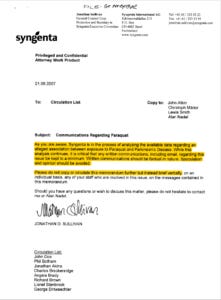
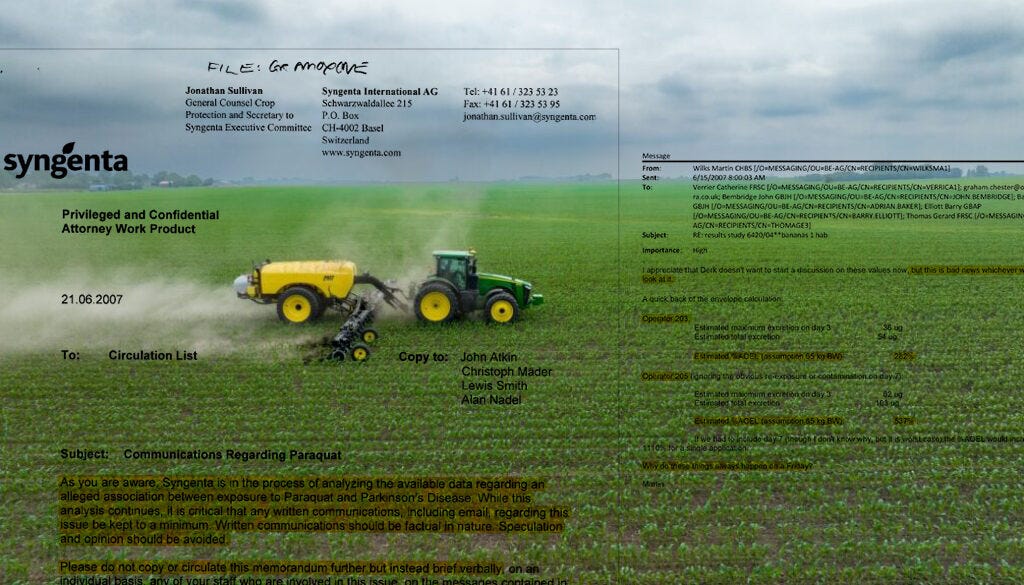
The company’s internal documents indicate that secrecy was an element of the campaign. In a 2007 email, company officials discussed a need to minimize written communication on an analysis of paraquat and Parkinson’s data. Even that message itself should not be shared in writing, but should be communicated “verbally” to staff.
In a 2011 email, Syngenta scientists discussed a “PD [Parkinson’s disease] Risk Factors Paper” they wanted to be published as an “independent review” under the authorship of a lead researcher outside the company named Jack Mandel. Mandel, formerly an epidemiologist with the University of Toronto school of public health at that time was a scientist with the contract research company Exponent, according to the email.
The email between the Syngenta scientists discussed making revisions, “editorial changes,” and working to “refine and improve” the manuscript even though no Syngenta employee would appear as an author. The correspondence stated that communication to the outside author “ideally” should “occur verbally”, and that because the paper is to appear independent, “we cannot be seen to try to influence.”
It additionally noted that Mandel “prefers not to engage in such exchanges because he knows he might be a witness someday.”
The files reveal a host of other intriguing details about internal Syngenta workings. Here are a few: Full story and documents
- Syngenta cultivated relationships with certain EPA personnel, including at least one who left the regulator to join Syngenta and lead its “FTO” or Freedom to Operate agenda. That former EPA toxicologist bragged in an internal 2017 Syngenta email that he had “been able to leverage” his EPA connections to “further our FTO interactions.”
- At one point, a Syngenta predecessor was developing a drug to treat Parkinson’s disease, spurring internal debate about the “cast-iron defence case” the company would need to make if they sold a drug to treat a disease their pesticide was suspected of causing.
- During the Obama administration, when the EPA was proposing stronger environmental regulations, including on pesticides such as Syngenta’s atrazine weedkiller, Syngenta officials appeared to take at least partial credit for spurring a political backlash against the administration and the agency. In a 2010 internal email string discussing the EPA’s “anti-agriculture actions” and resulting heavy public criticism of its actions, a Syngenta executive noted it was “‘open hunting’ season on the EPA, a good thing from our point of view.” Citing a “good turn of events”, he wrote “Well done to our team and their networks for helping to catalyze it all.”
TNL is sharing all the documents used as material for this story and more in this Paraquat Papers database.
At Sterling Publishing & Media Service Agency, we prioritise transparency and accountability in all our operations. We wish to clarify that we are not responsible for any external content, hyperlinks, or costs associated with our services. Nevertheless, we remain committed to delivering outstanding services and greatly value your continued support. Thank you for your trust in us.

